What makes someone fully human? Is it strength, achievement, wisdom, moral conduct, social recognition, or the ability to live responsibly within a community? In Achebe’s Mmadụ: Personhood at the Crossroads of Story, Theology, and Culture, Emeka Nzeadibe explores these questions through two of Chinua Achebe’s most unforgettable characters: Okonkwo in Things Fall Apart and Ezeulu in Arrow of God.
Both men hold respected positions within their communities. Okonkwo earns fame through hard work, physical strength, courage and personal achievement. Ezeulu carries the spiritual authority and sacred responsibilities of a chief priest. On the surface, they appear to represent successful personhood. Yet their stories reveal that status and power cannot fully define Mmadụness, the quality and reality of being a human person.
Okonkwo’s identity is closely tied to his fear of weakness. He works relentlessly to distance himself from everything he associates with failure, especially the memory of his father. His success brings honor, but his rigid understanding of masculinity makes compassion difficult. He becomes trapped between his private fears and the expectations of his society. His tragedy shows how a person may gain public recognition while losing emotional and spiritual balance.
Ezeulu faces a different struggle. As chief priest, he stands between the divine, the political life of the community and his personal judgment. His authority depends on sacred duty, but it also brings tension, pride, isolation and conflict. His choices affect not only his own destiny but the well-being of the wider community. Through him, Achebe explores the danger of allowing spiritual office, personal conviction and social authority to become inseparable.
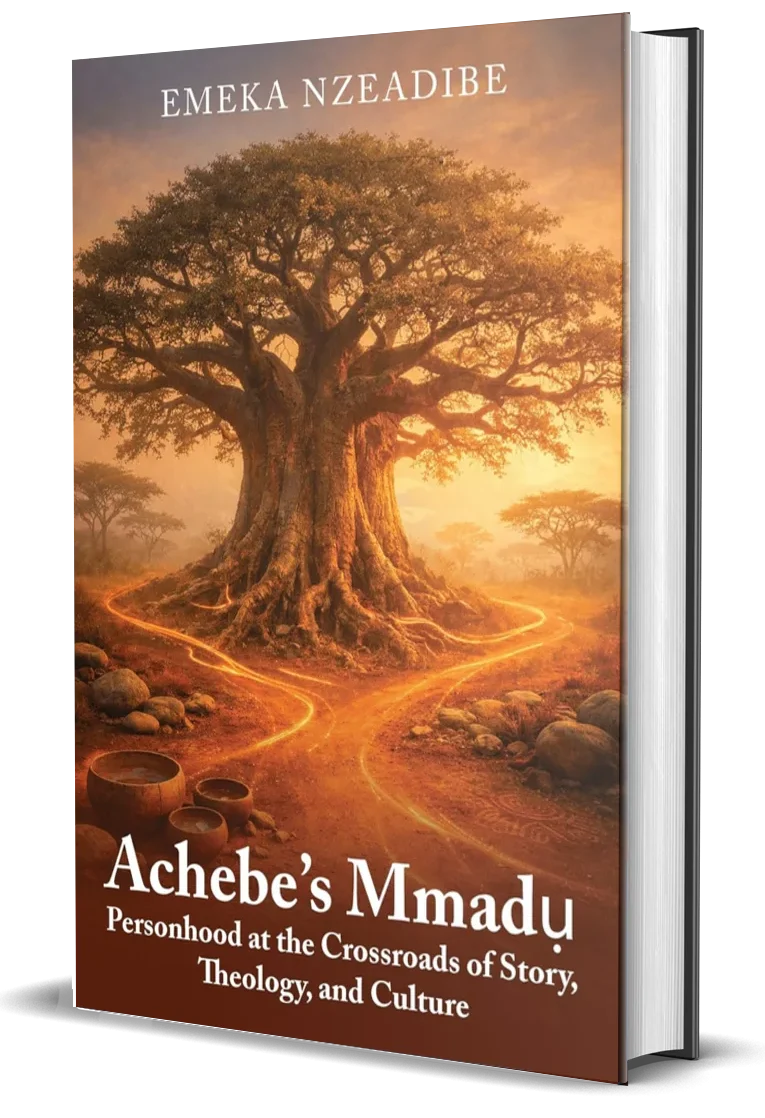
Nzeadibe reads both characters through the Igbo concept of Mmadụ, which presents the human being as relational, embodied, responsible and spiritually connected. A person exists within a web of family, community, tradition, ancestors and divine realities. However, the individual is not simply absorbed into the group. The concept of Chi preserves each person’s uniqueness, agency and spiritual identity.
This tension between individuality and communal belonging is central to the journeys of Okonkwo and Ezeulu. Both men shape their communities, but they are also shaped by them. They make choices, accept responsibilities, resist pressures and suffer the consequences of their actions. Their stories demonstrate that Mmadụness is not a simple reward for social success. Wealth, titles, authority and reputation may influence how society judges a person, but they do not create or remove that person’s fundamental dignity.
That distinction gives Nzeadibe’s book its moral force. Okonkwo and Ezeulu may fail, but they do not stop being human. Their flaws do not make them less worthy of serious understanding. Achebe refuses to present them as either heroes without weakness or villains without humanity. Instead, he shows them as complicated people caught between fear and courage, freedom and destiny, personal ambition and communal responsibility.
Achebe’s Mmadụ invites readers to look beyond the rise and fall of these characters. Emeka Nzeadibe reveals how their lives become profound reflections on identity, dignity, responsibility and belonging. Through Okonkwo and Ezeulu, readers discover that the search for Mmadụness is not about achieving perfection. It is about recognizing the sacred complexity of the human person even in failure, conflict and tragedy.
Read the book on Amazon: https://a.co/d/0363OG8A