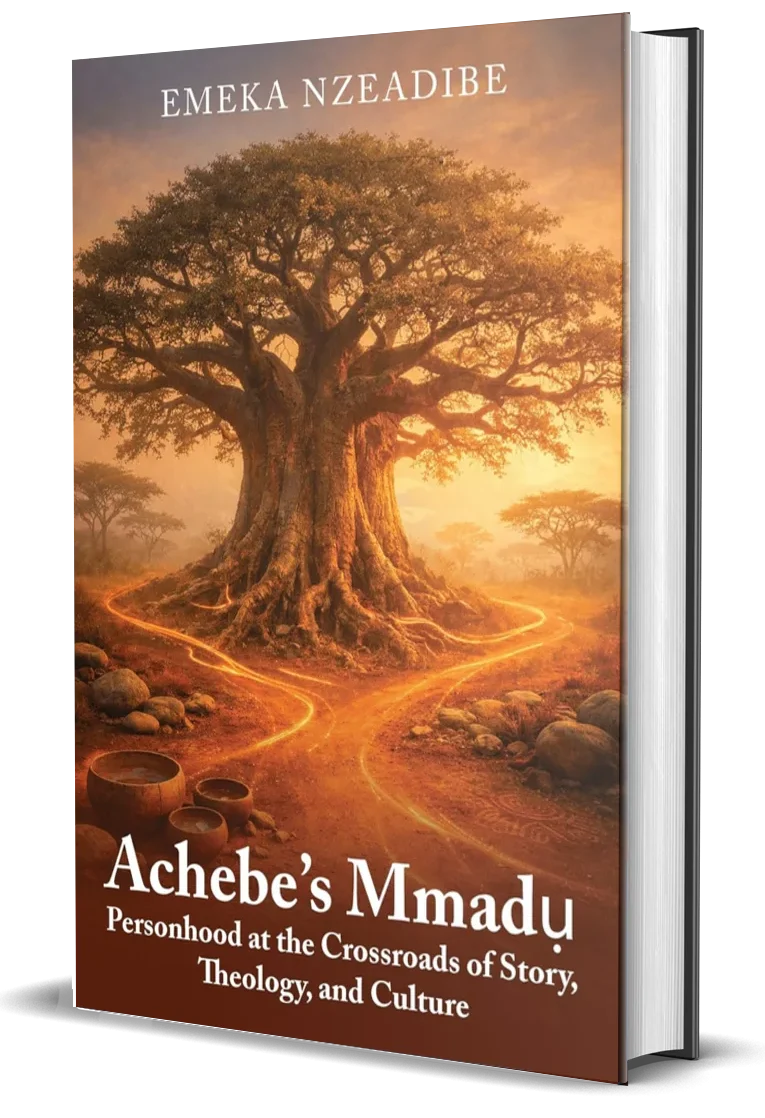
Who is Mmadụ? It is a deceptively simple question, yet it opens the door to some of the most important discussions about identity, dignity, culture, faith and belonging. In Achebe’s Mmadụ: Personhood at the Crossroads of Story, Theology, and Culture, author Emeka Nzeadibe explores this question through Chinua Achebe’s literary imagination and the philosophical depth of the Igbo worldview.
The word Mmadụ may be translated as “human being” or “human person,” but Nzeadibe shows that its meaning cannot be reduced to a dictionary definition. Mmadụ includes personhood, consciousness, subjectivity, humanity and the ways a person interacts with the surrounding world. The book therefore asks not only what a human being is, but what makes a person fully recognizable as a person.
This question becomes especially powerful in Achebe’s stories. Characters such as Okonkwo and Ezeulu are not merely fictional figures placed inside historical events. They are complex human beings shaped by family, custom, ambition, fear, spiritual responsibility, personal choice and communal judgment. Through their lives, Achebe reveals how personhood develops at the meeting point of the individual and society.
Nzeadibe’s study emphasizes that Mmadụ is fundamentally relational. A person exists within a network of connections that includes family, community, ancestors, spiritual realities, culture and the divine. Human identity is not formed in isolation. People come to understand themselves through recognition, responsibility, participation and relationships with others.
However, the book does not allow the community to erase the individual. This is where the concept of Chi becomes essential. Chi is closely connected to individuality, spiritual identity, destiny and personal uniqueness. The community may influence Mmadụ, but Chi protects the idea that each person is more than a social role, public reputation or communal expectation. A human being belongs to others while remaining a distinct and responsible self.
Another important distinction in the book is between inherent and socially recognized personhood. Societies often measure people by achievement, wealth, title, maturity, moral performance or usefulness. Yet Nzeadibe argues that such conditions cannot determine a person’s deepest worth. Social status may change, but the fundamental dignity of Mmadụ remains inviolable.
The discussion becomes even richer when Mmadụ enters into dialogue with the Christian idea of imago Dei, the belief that human beings bear the image of God. This theological connection supports the claim that dignity is not earned. It belongs to every person regardless of origin, gender, success, failure or social condition.
Storytelling is the thread that brings these ideas together. Achebe’s narratives resist colonial depictions that reduced African people to stereotypes or objects. By portraying people in their moral complexity, cultural depth and spiritual seriousness, his stories insist that they be seen as fully human. Nzeadibe develops this insight further by presenting storytelling as a vessel through which personhood is remembered, expressed and restored.
So, who is Mmadụ? Mmadụ is the individual who stands in relationship with others without losing personal uniqueness. Mmadụ is a bearer of dignity, responsibility, history and spiritual meaning. Through this compelling exploration, Emeka Nzeadibe invites readers to reconsider not only Achebe’s characters, but also the standards by which we recognize humanity in one another.
Read the book on Amazon: https://a.co/d/0363OG8A