Honestly, non-Western philosophies and critics often view communal societies as entirely deterministic, where the individual is submerged within the group and stripped of personal agency. However, the indigenous Igbo worldview, vividly brought to life through Chinua Achebe’s literary art, refutes this simplistic dichotomy. At the very center of individual identity and self-actualization lies one of the most complex, multi-layered concepts in African cosmology: Chi. Understanding how Mmadụ (the human person) interacts with Chi (the personal spiritual double) opens up a sophisticated window into how African thought conceptualizes destiny, freedom, and human choice.
What is Chi?
In Igbo cosmology, Chi is an individual’s personal spirit. It is considered a divine counterpart or alter ego, located in the spiritland. Given or acquired at birth, Chi acts as a guardian presence and the ultimate seat of individuality, which Chinua Achebe famously observed that while many cultures demonstrate the importance of the individual through the common fatherhood of God, the Igbo go a step further: they postulate an unprecedented uniqueness for every human being by making each person the sole creation and purpose of a unique divine agent, Chi. As a result, no two individuals share the same Chi, even if they are siblings or share the same traits. This introduces a radical foundation for human uniqueness and personal identity that operates far beneath surface-level social categorization.
One of the most famous Igbo proverbs encapsulating the dynamic between human agency and divine destiny is “Onye kwe, chi ya ekwe”, or “When one says yes, one’s chi says yes.” Far from reducing humans to passive pawns manipulated by fate, this aphorism highlights a philosophical reciprocit, where the maxim asserts that human will and divine accompaniment are intimately intertwined. Chi sets the horizon, but human effort, resilience, and personal responsibility activate the destiny contained within that horizon. As traditional wisdom dictates, even if a person possesses a “good chi,” folding one’s arms and sitting idly will yield nothing. People must proactively thrust into their environment through hard work, moral character, and active decision-making.
This delicate balance is further illuminated by another pivotal Igbo insight: “Chi onye adighi n’izu ihe anaghi eme ya”—“No matter how many divinities sit down to plot a man’s ruin, it will come to nothing unless his chi is there among them.” Here, Chi serves as a protective guardian ensuring that an individual is never entirely at the mercy of capricious external forces without a profound, underlying metaphysical anchor.
While Chi grants freedom and individual potential, it also sets moral and existential boundaries. Challenging one’s Chi through arrogance, hubris, or an absolute refusal to adapt to reality invites disaster.
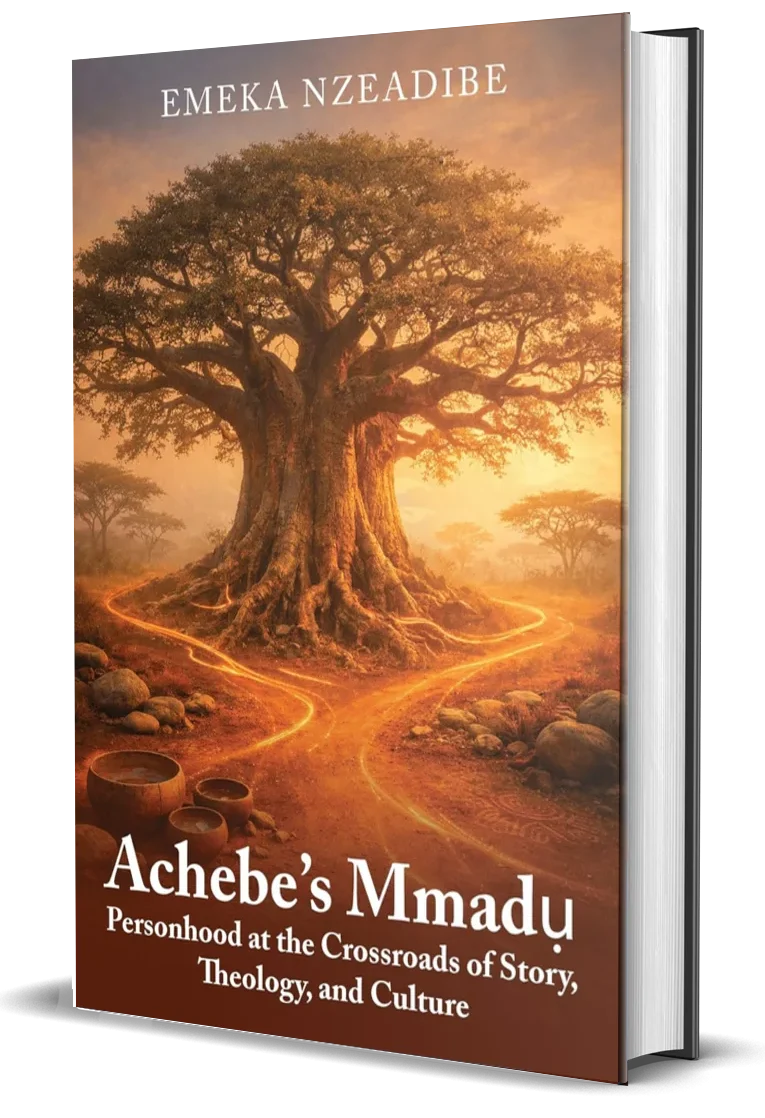
In Achebe’s classic novels, masterfully analyzed in Emeka Nzeadibe’s monograph Achebe’s Mmadụ: Personhood at the Crossroads of Story, Theology, and Culture, protagonists like Okonkwo and Ezeulu grapple intensely with their destinies. Ezeulu, the Chief Priest of Ulu in Arrow of God, views himself as “an arrow in the bow of his god”. Yet, blinded by rigid pride, vengeance, and an unyielding interpretation of his sacred duty, he pushes his standoff with his community to the breaking point using his Chi. This tragic downfall illustrates that while humans are endowed with immense agency, totalizing inflexibility and the refusal to harmonize personal will with communal well-being rupture the cosmic fabric.
The concept of Chi defies rigid, dogmatic categorization, existing instead in what literary and theological scholars call hermeneutical indeterminacy. It encompasses fate, fortune, luck, and the unexplainable extra-rational elements of human experience without locking the individual into fatalistic despair.
Ultimately, the interplay between Mmadụ and Chi teaches us that human freedom is neither absolute license nor predetermined bondage. By maintaining a harmonious, reflective relationship with our inner spiritual guide, we walk the path toward Ụbandụ: ontological wholeness and the true realization of human potential. Read Achebe’s Mmadụ to move beyond the conflict between self and society and embrace a vision of humanity grounded in relationship, freedom, responsibility, and dignity. Through Achebe’s stories, the human person appears not as an isolated self or a faceless member of a group but as someone who becomes fully human in meaningful connection with others.
Read the book on Amazon: https://a.co/d/0363OG8A