In contemporary philosophical and psychological discussions, the definition of the human person defaults to a Eurocentric paradigm of isolated self-consciousness, which can be characterized as selfishness. We picture the self as an autonomous, self-contained ego navigating the world independently, where identity is primarily an internal achievement of mind and private will. However, if we were to move our gaze toward indigenous African intellectual traditions, we can understand a radically different perspective. Grounded in Chinua Achebe’s evocative literary imagination and the traditional Igbo worldview, the concept of Mmadụ, aka the human person, shatters the illusion of the solitary self, presenting instead a vision of humanity anchored in embodied relationality.
Mmadụ
To understand what it means to be human through the lens of Igbo philosophy, we must first look at the etymology and profound ontological weight of the word Mmadụ. Scholars and thinkers offer various insights into its roots: some trace it to Mma (beauty, goodness, virtue) and Ndu (life, existence), translating Mmadụ as “the beauty or goodness of life”. Others render it as “There is goodness” or a synthesis of all that is good in creation. This positions the human person not merely as a biological entity (Homo Sapiens), but as the aesthetic and ethical culmination of the creative act.
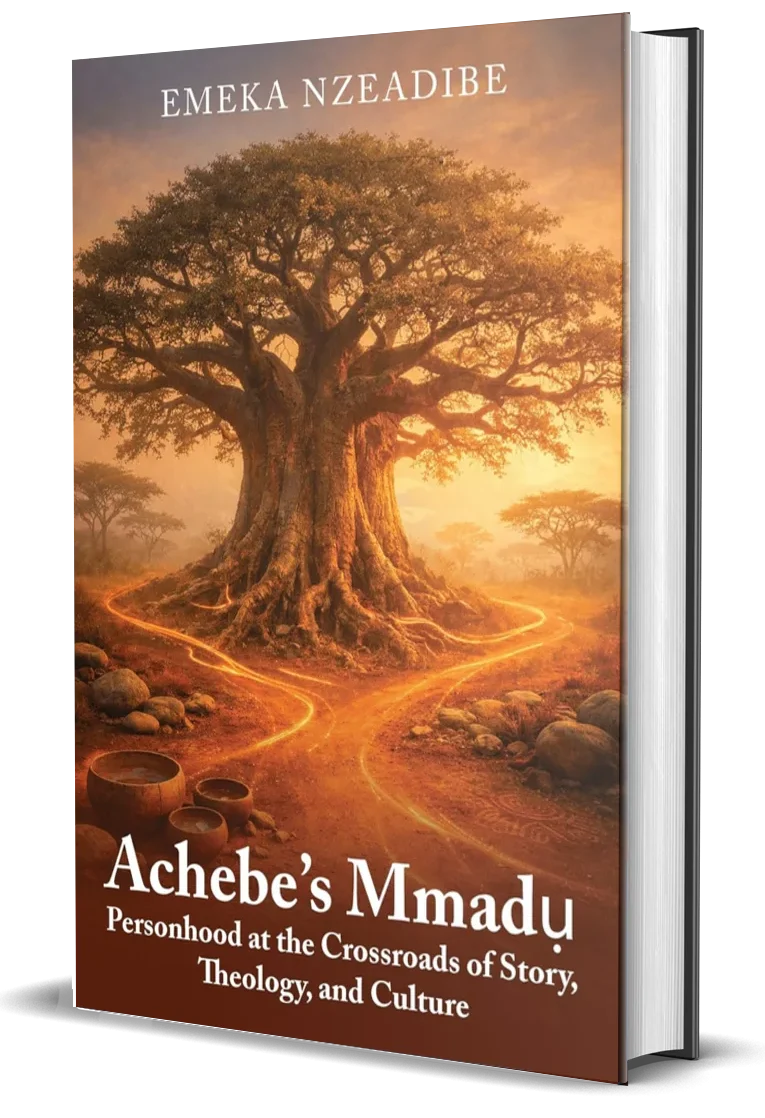
Unlike reductionist views that evaluate human worth based on narrow functional capabilities, the Igbo concept of Mmadụ treats human existence as an intrinsic ontological reality. As explored in Emeka Nzeadibe’s monograph Achebe’s Mmadụ: Personhood at the Crossroads of Story, Theology, and Culture, Mmadụ is always “someone” and never “something”. It is an unassailable reality integral to human dignity that cannot be detached from the living body and the community. Igbo worldview is a foundational philosophical maxim famously highlighted by Chinua Achebe: Ife kwụlụ, ife akwụdebe ya—”Where something stands, something else stands beside it”. This profound philosophical principle asserts that nothing and nobody stands alone in the universe. Every individual is inherently enmeshed in a vast, intricate network of relationships.
In traditional Igbo society, a person cannot be understood in isolation from family, kin, community, the natural environment, and the spiritual realm. This relational ontology challenges modern individualism by asserting that identity is never self-enclosed. Instead, who we are emerges through active moral participation, kinship ties, and interactions with others.
Tragic literary figures like Okonkwo in Things Fall Apart vividly demonstrate the peril of violating this relational balance. Okonkwo’s obsessive drive for hyper-individualized strength, his rejection of the feminine principle, and his inability to act in concert with the evolving dynamics of his community ultimately lead to his isolation and tragic downfall. His fate illustrates that an individual who severs themselves from the communal fabric undermines their own humanity.
Crucially, Mmadụ is not a disembodied intellect; it is deeply physical and enfleshed. Corporeality serves as both the medium of communication and the emblem of individual identity. Physical existence is so intimately tied to personal integrity that assaults on the body are viewed as deep violations of the personal essence.
Furthermore, true Mmaduness requires psychological wholesomeness: emotional and rational stability, communal adjustment, and consistent sound judgment. Characters like Obierika—who takes the time to think, reflect, and question unexamined cultural dogmas—exemplify a balanced integration of internal reflection and communal responsibility.
A Living Resource for Today’s World
In a twenty-first-century global society increasingly plagued by hyper-individualism, alienation, and social fragmentation, the Igbo philosophy of Mmadụ offers a powerful corrective. It reminds us that human dignity is not earned through ruthless self-reliance, nor is it a solitary mental construct. True personhood is an ongoing, dynamic journey of becoming—realized through our responsibilities to one another, our rootedness in community, and our recognition that wherever we stand, we stand in vital, sacred relation to others.
Achebe’s Mmadụ offers a timely message for a divided world. Emeka Nzeadibe invites readers to move beyond the conflict between self and society and embrace a vision of humanity grounded in relationship, freedom, responsibility and dignity. Through Achebe’s stories, the human person appears not as an isolated self or a faceless member of a group, but as someone who becomes fully human in meaningful connection with others.
Read the book on Amazon: https://a.co/d/0363OG8A